
Written and published by Nihilitus
Date of publication: June 01, 2023.
Prometheus is a 2012 science fiction film directed by modern film legend Ridley Scott. It was originally planned to be a prequel to the 1979 film “Alien”, however, the characters it introduces (the engineers, the deacon, the humans and the androids) and the story it tells (the origin of life and the power to control it) make it so complex that it ends up creating a universe of its own. Its plot questions the divine intervention in the creation of life.
Movie:
Prometheus
Director:
Ridley Scott
Studio/Year of release:
20th Century Fox/2012
To this end, it introduces the engineers, an alien race with physical similarities to humans, but with an advanced technological development. In the first scene of the film we see how a group of these beings (apparently all male figure) arrive in their spaceships to a desolate planet (apparently lifeless). In a ceremonial tone we see how one of them approaches the bank of a river with a vessel containing a colorful liquid that seems to have a certain kind of autonomy. Drinking it, the engineer begins to decompose until he falls into the river and is carried away by the flow. Finally, we see that his body disintegrates and ends up mixing with the water. The shot zooms in on the scene to see at the molecular level the disintegration of the alien. Its remains mix with the native components of the planet to form the basic DNA elixirs that later mutate into a cell.
The following video has been published for educational purposes. Copyrights by 20th Century Fox, 2012
This scene reveals part of the meaning of the film. It suggests that life is of alien origin because there are advanced civilizations that can intervene in the natural evolutionary process of the planets so that they can host it. However, and in spite of having advanced technology, the scene raises questions that complicate the problem. Why don’t these beings colonize the planets directly? Why don’t we see women or beings of feminine aspect in the scene? Why do the aliens wear clothes similar to religious tunics? Is the colorful liquid that the alien drinks the technology of its civilization, or an exotic organic compound extracted from somewhere in space? What are the implications of the alien’s sacrifice to create life on a planet that does not have it?

Of course Ridley Scott does not give a direct answer to these questions, he only leaves us some clues, but when we put them together they take a more coherent sense with a macabre reality that has cosmological repercussions. It is true that the civilization of the engineers is so advanced that they can travel to any planet and manipulate life at the molecular level, but for some reason that we do not know that this advance has deprived them of the natural ability to reproduce, besides having turned them into beings physically indistinguishable from each other, we speculate that it may be because of the genetic manipulation they have done for millennia. That is why the scene visualizes them as asexual beings, there is no distinction of male or female because it no longer exists. It seems, as the film suggests, that something catastrophic happens at some point in the molecular manipulation of life and it becomes inert or loses the ability to reproduce.
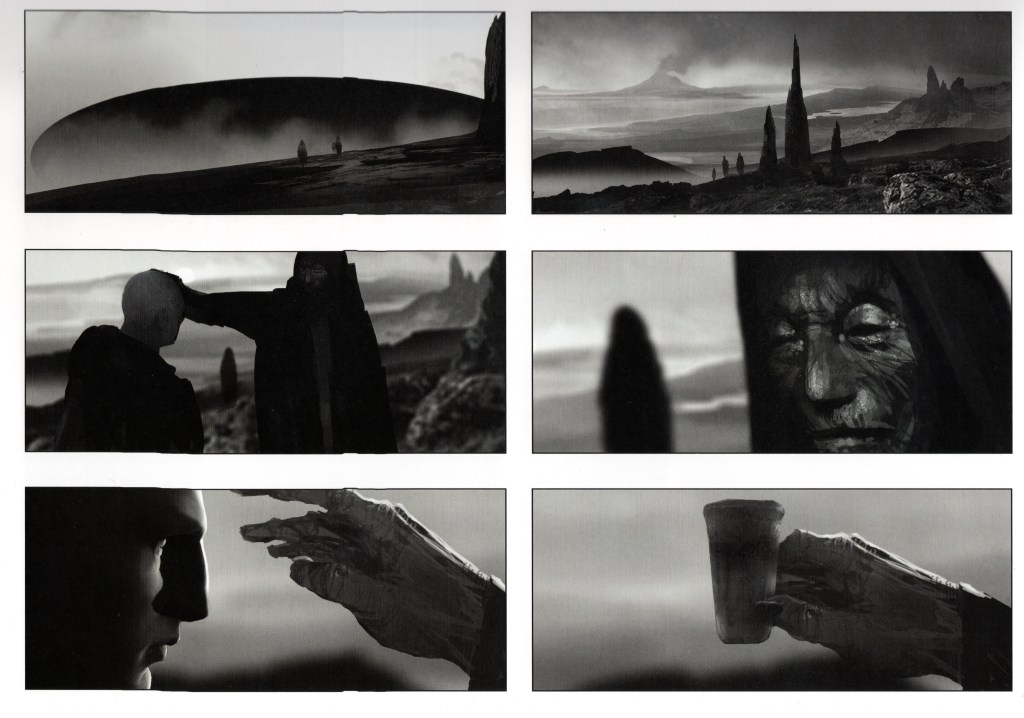
This would also explain why engineers do not colonize planets by establishing physical communities on their lands. They do not do so because they cannot, they are doomed to an extinction apparently of their own making. The only thing left for them is to cultivate life through sacrifice and with the help of an exotic organic compound whose origin is unknown, but would have religious implications.
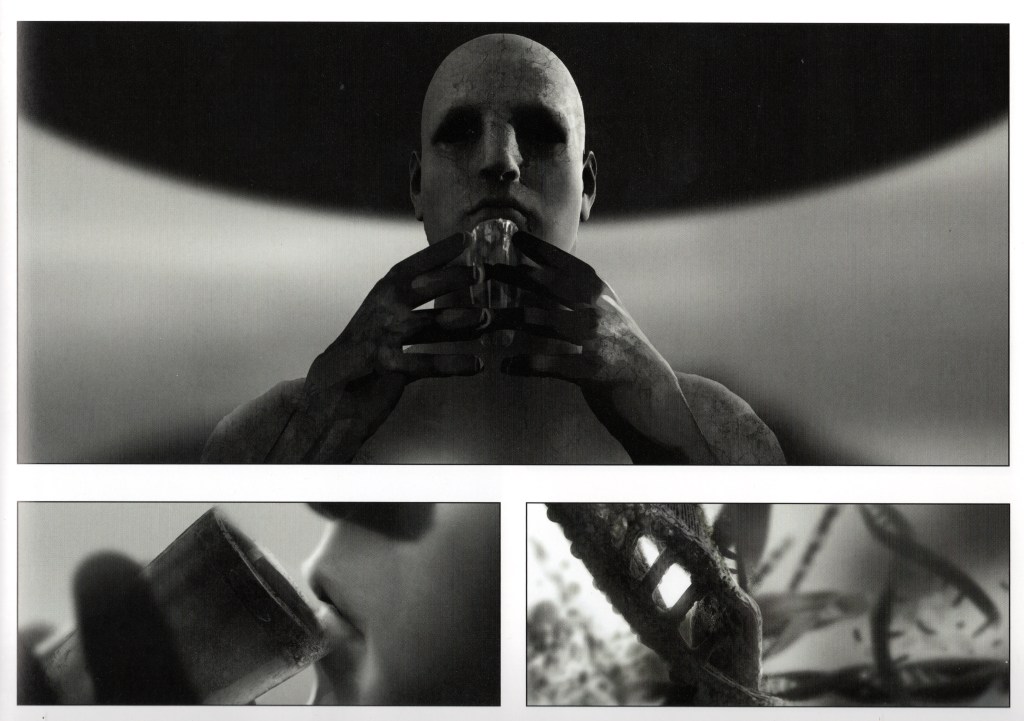
The way they are dressed, the ceremonial atmosphere they create gives us to understand that they are performing a ritual and it is accompanied by a black liquid put in a small container. Why would such an advanced civilization create an atmosphere of this type and push one of their own to sacrifice? This leads us to believe that there is a divine element to the process. Apparently the black liquid is not their technology, but it has the ability to create the life they have lost as a species. Thus the ceremonial act would make sense, and the engineer who drinks the liquid seems to be prepared to give his life in an act of sacrifice that is remarkable considering that they are a technologically advanced civilization. It is very important to note that the alien does not suffer a transformation or mutation, it dies directly in the act, but from its decomposition life emerges. The black liquid is an elixir of life that acquires that property when a being gives its life for a greater purpose. So we could argue on the basis of what the film suggests that this is an intelligent compound that adapts to the intentions of whoever possesses it, and as we will see later, in the human case, it derives in the formation of monsters that bring death, as well as it can create life in beings who have an altruistic vocation.
The following video has been published for educational purposes. Copyrights by 20th Century Fox, 2012
A later scene gives us clues to this dynamic behavior of the (protoconscious?) black liquid. The human explorers upon arriving on the moon LV-223 (because of the cosmological references they have found to ancient human civilizations) find a particular settlement, which is not natural. They assume it to be the ruins of an ancient civilization. On exploring it they discover a temple-like chamber where a monument in the shape of a human face rests. Around it are murals with figures of engineers, and on the floor lie hundreds of containers filled with the mysterious black liquid. There are two details that the explorers do not notice. The shots focus on some worm-like animals that begin to emerge from the floor as the black liquid begins to vibrate in some of the containers. One of the explorers senses that something is going on around them and verbally indicates that they are altering the atmosphere of the place.
The following video has been published for educational purposes. Copyrights by 20th Century Fox, 2012
In one part of the chamber rests a large mural where a non-human figure (the deacon) is drawn with his limbs outstretched. Apparently it is an alien being who is worshipped by the engineers. In front of it there is a structure on which rests some kind of mineral or exotic rock. The explorer who discovers this place concludes that it is a ceremonial temple.

Leaving the chamber, two of the explorers get lost and have to wait to be rescued the next day. Both decide to go into the place to explore, but the place is no longer the same. The worms that emerged from the bottom of the ground come into contact with the black liquid that begins to spread due to the atmospheric alteration of the human presence. Subsequently we see that the small beings have become something like huge snakes and find in the disoriented humans their first victims. In effect they kill them, but they also incubate in them another kind of life. One of the victims will thus become a monstrous being with supernatural strength who will go out in search of his fellow explorers to repeat the same process.
There are several observations to be made. First, the mysterious chamber where the black liquid rests has a religious component, that is undeniable, not only because of the monument with a human face that is in the place, but also because of the mural where the deacon is drawn as a divine creature. So these three elements are related. What the film suggests is that the exotic liquid emerges from a cosmic force that is venerated by the engineers. Why the veneration? It is because of its miraculous, life-creating capabilities, something the engineers have lost.
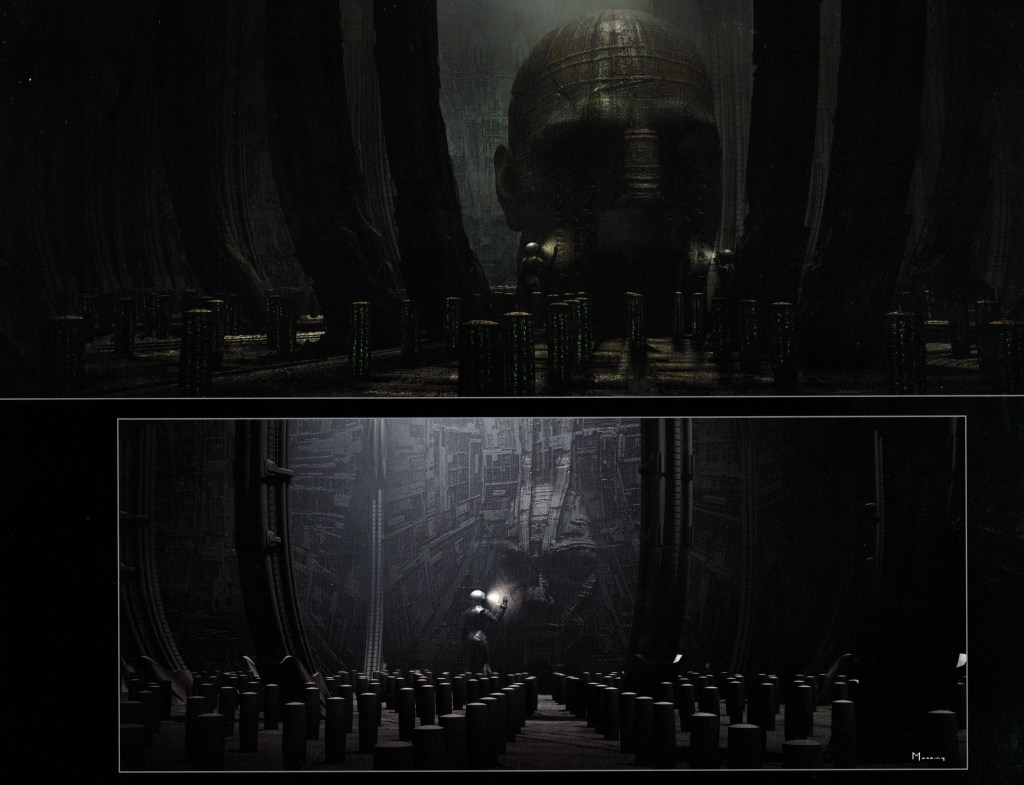
Second, the black liquid is not a sterile object that can be used in any situation. Here the film reveals its use in contrast. At the beginning we saw how one of the engineers drank the liquid to die and that act of sacrifice created the conditions for life to emerge, but in the human case the opposite happens. When the explorers enter the chamber we see an alteration of its components, the black liquid begins to shake until it infects worms that turn into snake-like alien animals and pass the mutation to one of the explorers who ends up becoming a monster. To understand this part we must start from the purposes, from the intentions of each civilization. The aliens are not exploring the universe for mercantilist purposes, but because they understand that life is valuable and needs to be cultivated even if it implies the sacrifice of their species. In opposition humans are exploring the universe to control it, to extract their knowledge to obtain economic, political and cultural power. Thus we see what is the end of the alien that disintegrates, but somehow will keep his memory alive as an inheritance that leaves a planet that has no life, but will have it for the altruistic purposes of the engineer. In the human case, the explorer becomes a monstrous being that seeks to contaminate all forms of life in order to destroy it.

This makes us think how difficult it is to understand life. It is not a manipulable object that we can alter with complex calculations and predictions. The philosophical approach of vitalism argued that the motor of life was an unobservable force that animates beings to experience reality, the elen vital. This component is integrated in the will which is a subjective property that is only accessible to the one who lives the experience of life, that is why it is not objective. Understood in this way, life has a mystical component and philosophies such as panpsychism have argued that it is not exclusive to organic beings, but is spread throughout the universe. It is not unusual that it has acquired religious properties over the centuries.
Ridley Scott’s film reflects something of this complex reality and leaves a resounding warning to humanity. Following the path of deterministic and causalist scientism will only lead us to perdition, turning us into unrecognizable beings, monsters eager to cultivate death throughout the universe.
We missed to analyze the role of artificial intelligence in this film, because it is an important component that is also in vogue with current trends in technology. We will review that part later when we analyze some excerpts from the film that followed as a sequel to Prometheus, Alien Covenant.
 Nihilitus