
Written and published by Nihilitus
Date of publication: March 27, 2022.
Morbid Angel is a death metal band from Florida, USA. Their third official album, “Covenant” (1993), marked a milestone for the underground metal circuit. This work was released through Giant Records, a multinational company subsidiary of Warner Bros. Morbid Angel became the first death metal band to sign with a multinational, and although their fans believed their style would become more commercial, it was quite the opposite.
Band:
Morbid Angel
Album/Year of Publication:
Covenant/1993
Company:
Giant Records/Earache Rec.
The following video has been published for educational purposes. Copyrights by Giant Records and Earache, 1993.
“Covenant” is their most mature album, their best work to put it in other words. Musically it is perfect and is at the same level of Metallica’s “Master of Puppets” (both works coincide in having the same producer, the Swedish Flemmin Rasmussen). But it is also their most satanic album, more violent and dark. This work explores the philosophical dimension of emptiness and darkness in human nature, as well as its consequences for life (the glorification of death and the triumph of evil). “Covenant” reflects that humanity is incompatible with life, because it prefers to embrace darkness. And of course, in these conditions it is inevitable to invoke the figure of Satan as an archetype of this irrational behavior of humanity or in Jungian terms it would be the equivalent of stating that the shadow imposed itself and is the one that governs human interaction with itself and reality.
“Covenant” is the representation of a chaotic world, doomed to emptiness and darkness. Morbid Angel cleverly captured this idea and unveiled it collectively. That is why they sold more than 120 thousand copies and became (in their time) the most successful death metal band on the planet, and the best thing is that they did it without concessions. This reflection is not intended to magnify the evil of the world, but to clarify that for an artist (in this case musicians) it is gratifying that their work is respected and admired even when it is challenging or questioning the semantics of social behavior (which includes the religious, political and cultural in general).
Two videos reflect this golden age of death metal. “Rapture” and “God of emptiness”. It is the second video clip the one we take for the analysis in three dimensions: the visual construction, the unveiling of a political-religious message and the philosophical implications of the visual proposal. The band’s glorious moment was not wasted. David Vincent and the rest of his band created in “God of emptiness” an exceptional artistic video that accurately reflected the dark message hidden in their work.
THE LOOK

“God of emptiness” videoclip was complete filmed in black & white
The first remarkable thing about this music video is the filming was made entirely in black and white. English filmmaker John Boorman suggests that such colorless shots create a sense of parallelism between two worlds. In his essay on the influence of black and white in modern cinema, Justin Morrow argues that the technique seeks to represent something that is totally unreal, thus creating the conditions for a new reality captured on video. It also creates a bridge to the dream world, to the unconscious. These two theoretical references are important because they fit with what we see in “God of emptiness”, the contraposition of two worlds, the human world and the world of divinity (which is beyond earthliness and objectivity). The video relates the (unconscious) subversion of darkness (which represents freedom linked to fantasy, sexuality, creativity, knowledge and the inevitable self-destruction of the person who carries it) against light (whose manifestation of order derives in obedience, the imposition of hierarchies, the respect and worship of deities and finally an agonizing death without purpose or meaning).
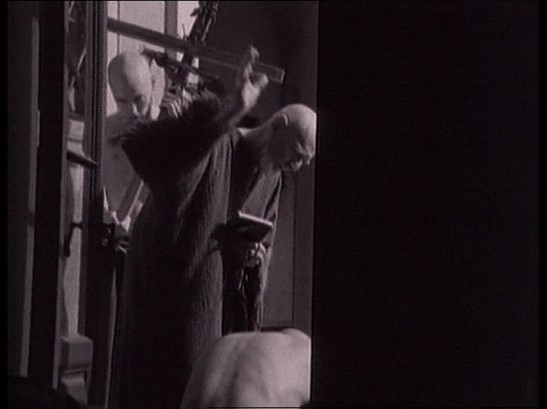
The alienation that comes with religious fanaticism (oppression and discipline)
In that contraposition we see two types of humans following totally opposite patterns of behavior because they are holders of incompatible moral values. Each is identified with opposite metaphysical realities that the video tries to represent aesthetically. That is why black and white is used as a visual technique because there is no better way to contrast order as the principle of life versus chaos as the principle of death. By including objects and physical manifestations linked to religious discourse (crosses, temples and the demonic conversion of the human), the video clearly represents the metaphysical opposition of God and Satan.
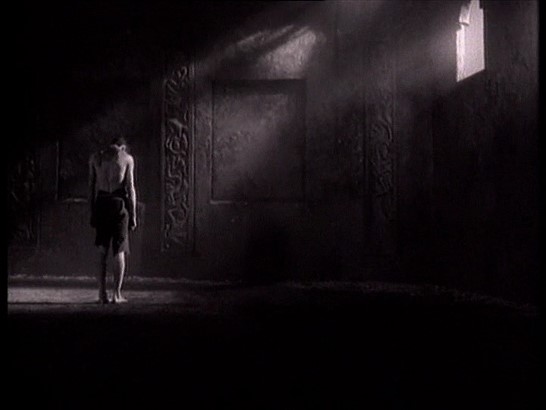
Freedom associated with opposition, individualism and darkness
THE POLITICAL AND RELIGIOUS MEANING
“God of emptiness” shows a dispute of religious, but also political meanings. Let’s start with the first one. The content is divided into two parts, the accuser and the tempter. The accuser questions the absolute power of divinity based on lies, oppression and obedience. The first part of the lyric composition reads as follows:
Lies, and you fill their souls
With all oppressions of this world,
And all the glory you’ll receive?
So, what makes you supreme?
Lies, and your crown is falling.
I offer fantasy, and you
Create the blind with envy
But the accuser also claims that this kind of power is declining because no absolute power is natural and will eventually self-destruct because of the natural attraction of the oppressed to an opposing power. Visually there are two moments in which this relationship can be read. There are two types of humans that appear in the video. The first is the individual regular human and the other is a group of religious fanatics. Both are crossed by the same religious influence, although their reactions are different. In the group of fanatics, we see an aesthetically disciplined behavior represented in the same way of dressing, in the physical appearance in which they all wear shaved heads and the use of symbolic objects such as crosses. But also, the position of their bodies, their expressions and the way they relate to each other indicates a state of collective alienation where individuality is neither allowed nor cultivated. They are the followers of the God of light who experience reality with the limitation imposed by fanaticism: discipline, punishment, the repetition of the same rituals, the annulment of individual personality. This is a meaningless life because individuality has been absorbed by a divine will that, through emissaries, imposes social behavior as well as its values.
The narrative becomes political when the power dispute between the individual subject and the divine supreme entity that emanates its influence through light is depicted. An interesting aspect of this dispute is the prominently dark background in which the human and the divine interact. It is a way of indicating that for the free man all options of realization are present (both darkness and light are part of his nature, but he can choose between them) unlike the disciplined subjects to whom the environment in which they interact is imposed, therefore, they assume that this condition is natural and it follows that they will never question it.
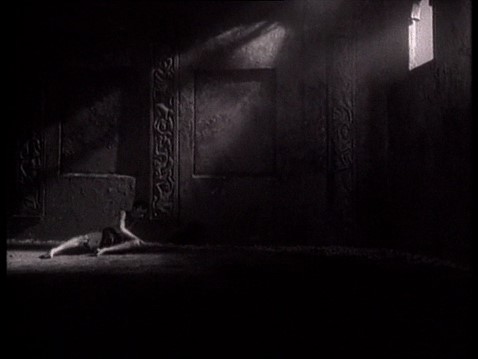
The act rebelion from individual human againts God and his absolute power
The story becomes interesting when the individual character distances himself from the light, loses his influence and in the end falls into the void (of darkness) from where he will be reborn. This sequence shows that no power is absolute because the individual nature (his will) will always try to challenge it. This representation could well be applied to political power disputes in fascist dictatorships that oppress and bend individuality until it is annulled. Of course, the video does not use a political language, but a religious one, but ontologically it discusses the problem of absolute power and its inconsistency with the human will.
In one sequence of the video, darkness speaks through the tempter (Satan archetype) and reveals why its nature is so attractive to the individual subject to the point that he ends up embracing it and identifying with it. Invoking freedom, fantasy, free sexuality and passion, darkness captures the human’s attention to make him part of himself. The second part of the spoken narrative of the composition unveils this reality:
Let the children come to me
Their mother loves me, so shall they
Woman, bleeding, ate my gifts
Man was close behind
Through my world divine
Just like a snake I’m slithering
And like the cat I’m stalking
I’ll take your soul and you’ll be like me
In emptiness, free
THE PHILOSOPHICAL APPROACH
The video ends with an interesting transformation of the individual subject who defies absolute power to the point of freeing himself from it. This is a process of conversion that has consequences, and this is where the video explores philosophical territory. While it is suggesting that freedom is innate to human nature, cultivating and embracing it has consequences. In the video we see the individual subject stepping away from the light in defiance of absolute power. When freed from oppression, and being part of the darkness, the subject falls into the void, or in other words discovers his freedom and unleashes his radical transformation. The individual subject begins a process of demonization by which he becomes a monster with wings who decides to leave his prison to explore the world. There are several figures or archetypes that can help us understand this process. From mythology Prometheus, and from religion we can invoke Lucifer, the angel of light.
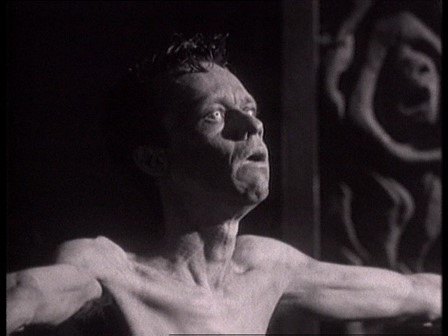
The human transformation phase 1: the enemy of God
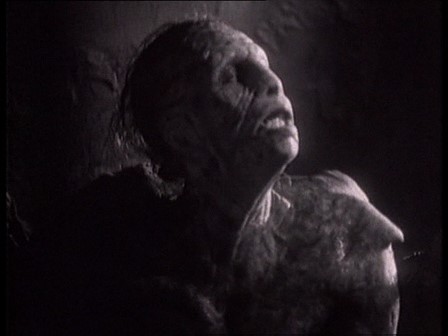
The human transformation phase 2: freedom demonizes human
Both are rebellious figures who not only defy the power of the gods, but carry the knowledge of being free. This is dangerous because their purpose is to warn power that its greatest fear should not lie in the anger or vengeance of the oppressed, but in their cultivation of freedom as knowledge, consequently, they will rationalize their condition and inevitably seek to appropriate power because only then they can be free in body and mind. However, freedom entails consequences. Freedom cultivates the creativity that comes with scientific knowledge in all areas of human life, and that can lead us to build more sophisticated forms of oppression or destroy nature by putting the needs of human freedom first, or worse, to try to reproduce the human will in a laboratory by creating cyborgs or conscious robots that serve the purpose of absolute power. The conversion of the human to the demonic that the video visualizes carries that interpretation, that is why freedom is deeply attached to emptiness, to darkness because it is not known what kind of reality will emerge if the human being becomes the shifter and the creator of his own nature. The history of humanity has shown that this path is deadly because it has led to the Anthropocene, the destruction of nature, the self-destruction of the human being and the massive annihilation of life throughout the planet. Freedom and darkness in that sense are compatible, they are a naturally attractive power, but they invoke death and the emptying of life.
 Nihilitus