
Written and published by Nihilitus
Date of publication: March 27, 2022.
The film “Natural Born Killers” (1994) directed by Oliver Stone is a satire that represents the American and capitalist society of the mid-nineties. It criticizes the media spectacularization of violence. It focuses on two issues.
First, it questions media violence and the effects it can have on audiences by altering their senses, which in the end may end up confusing what is real with what is represented. This is the problem of the simulacrum created by the media where a “false” reality is represented, which can lead to the desensitization of violent events.
Movie:
Natural Born Killers
Director:
Oliver Stone
Studio/Year of release:
Warner Bros/1994
The power of the image in the society of the spectacle
Second, the condition of the spectator is criticized as part of the spectacular media framework, without which the media structure would become dysfunctional. It is under a feedback mode that media contents come to life because audiences identify with them, hence the spectacle is a mirror through which society looks at itself, and to illustrate the problem, the film uses the figure of the serial killer as a media celebrity that awakens a kind of collective fanaticism (the identification of the masses with the spectacle) and, in addition, promotes a lucrative symbolic market of anti-values (the capitalist reason that makes the spectacle possible).
In order to argue theoretically this problematic exposed in Oliver Stone’s film, some concepts and ideas proposed by theorists such as Debord, Boorstin and Baudrillard will be taken. Finally, two scenes of the film will be analyzed where it is possible to visually read the communicational, sociological and political content that accounts for the theoretical section and harmonizes the proposal that the director of the film wants to express to the audience.
The society of the spectacle is a category proposed by Debord (2005) to understand the process by which capitalism would operate through the media with the same logic of the market. That is to say, to turn every type of mediatized relationship into merchandise and utility, which not only alludes to products that can acquire the property of fetishes, but also to social relations where audiences become consumers of fashions imposed by celebrities within a great spectacle orchestrated by capital.
For Debord (2005) this process alludes to the construction of a consumer culture that is only possible through the strategic treatment of the image. The image is so important in this explanation because it is only through the image that capitalist culture is revealed in its essence, that of presenting itself as an immense assemblage of spectacle. But the spectacle for him is not only a collection of images, but a social relation between people mediated by images. And this, for Debord, turns the media into determining agents of political power, because not only they can operate culture, but they determine what exists and what does not exist in society. Thus, whoever is outside this framework of media spectacularity simply does not exist.
In order to have a better understanding of the media, it is important to analyze the power that the image acquired in television as the closest aspect to the truth that the media took advantage of to build the society of the spectacle.
This is a communicational problem that has been widely discussed in theory. The mass mediatized image has a convincing power that simply cannot leave any doubts about the facts it represents. This power is given by the constant repetition of representations. When images become icons, the image itself is capable of coming to life, and the things to which it refers become secondary. And indeed, the referent can disappear completely.
Boorstin’s (1962) contribution is interesting at this point because he introduces the categories of “denaturalization” and “derealization” by means of which he wants to explain the transition from the real world to the simulated world of represented images. According to Boorstin, the technologies of diffusion have constructed a new reality where the generation of collective meanings will be dependent on the mediatic creation of simulated and deceptive realities.. This structure is so complex that the new society will be reflected in the media and its meanings will take shape from this mimetic act. According to Boorstin, the consequence of this process derives in the “homogenization of experience”, in which the difference between individuals is flattened, and individuality is lost.
A fundamental contribution that enriched the understanding of the society of the spectacle came from Baudrillard who argued that the prominence of the culture of the image has produced a crisis of representation itself. Baudrillard will argue that behind this transformation is the power of the “simulacrum”. This term refers to the way in which we consume media content, which comes to become something more real than what it is supposed to be. In the elaboration of this proposal, Baudrillard (quoted in Thompson, 1995: 236) explains the four fundamental phases of representation in the media (free translation):
- The mediated image is the reflection of a basic reality. This first phase is easily recognizable in the code of journalists today, who, with their conventions and frameworks of objectivity, narrow bias and neutrality, assume that there is a natural correspondence between reality and the representations they produce.
- The mediated image hides and perverts a basic reality. In this second phase the representation is largely a distortion of the real conditions.
- The mediated image hides the lack of a basic reality. This third phase is probably the most difficult to understand. Here, Baudrillard argues that an objective representation of the real is impossible because the referent is a simulated reality. Therefore, representation does not hide from the real because there is in fact no truth.
- The mediated image has no relation to reality: it creates its own simulacrum. The fourth phase marks the end of social reality itself as an available referent. The connection with the referent may be lost completely. What is represented on TV is assumed to be more important than other forms of experience. At the same time, TV itself colonizes our lives everywhere. TV is integrated into our everyday environments so well that we can hardly notice its presence. Indeed, according to Baudrillard, these two senses of the screen transform the real (the screen colonizes the real, and the real is only “real” if it is on a screen), which means that images begin to take on independence in relation to the “real” world.
For Baudrillard (quoted in Thompson, 1995), it is the image itself that becomes the measure of all things, including our access to social reality. Everywhere socialization is measured according to exposure through media messages. Those who are not in the media are practically asocial. There is a counterproductive effect of living in a world of images because the world becomes less meaningful: information devours its own contents, it devours communication and the social. Here Baudrillard argues that the process of signification is simplified. Under these conditions, according to Baudrillard (quoted in Thompson, 1995), the media are not generators of socialization, but the implosion of social relations is the only type of relation created by the media – the masses.
The mass and the media are the shadow of each other, and when the dynamic of simulacra prevails, the institution known as the “social” becomes outdated, it is absorbed by the image. In this world, the individual becomes a pure screen, a world in which we form a mass, living most of the time in panic, beyond meaning (Baudrillard, quoted in Thompson, 1995: 240).
“Natural Born Killers”: the performance of spectacular mediatized violence
For the corresponding analysis, we propose to review the first two scenes of the film.
The first one draws in a general way the content of the whole film because it explains who the main characters are going to be (Mickey and Mallory Knox), what they do (they are serial killers turned into celebrities by the media), and they bridge the gap to the origin of their personalities (traumas of their childhood and adolescence), which helps to contextualize the film.
One of the striking visual elements in the film is the tendency to switch between color and black and white shots. This sudden change of shots (from color to colorless) reveals the intention to deliberately send a message.
The following video has been published with educational purpose. Copyrights by Warner Bros, 1994.
English filmmaker John Boorman (quoted in Burgess, 2013), who often shot in black and white in the 1990s, suggests that this type of colorless shots creates a sense of parallelism between two worlds. Furthermore, it is very close to the dream condition, with the unconscious. In Natural Born Killers, Oliver Stone employs this technique in several scenes to warn us about the border between reality and unreality. It’s just a movie, isn’t it? It also leads to the philosophical reflection of good versus evil. The barbaric brutality is masked with black and white shots in the first scene of the film. In this way the following problem is suggested. If murder and violence are culturally unacceptable issues, what happens when they are represented in the media? Do they not become dangerous attitudes for coexistence? Is it acceptable to turn them into merchandises subverting the initial sense they had?

Black shot of the first scene in Natural Born Killers. Source: Warner Bros, 1994
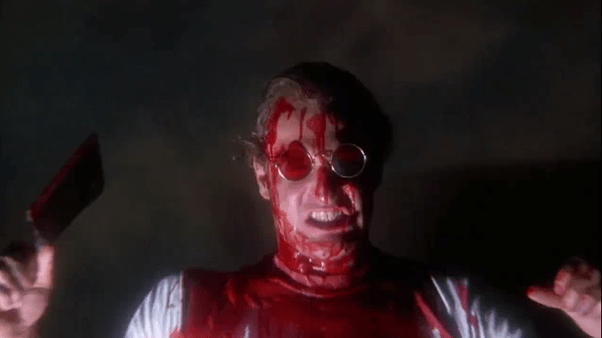
Color shot of the first scene in Natural Born Killers. Source: Warner Bros, 1994
This allows us to build a connection with Boorstin when he proposed the categories of denaturalization and derealization. With both he explains the transcendence of the world represented by the media and the implications it has for changing reality. If what appears in the media is more convincing and “real” because we can see it, then it becomes meaningless to live the experience directly with other senses that do not allude to sight. What Boorstin is suggesting is that behind this epistemic change there is a serious problem that alludes to simulation. If we lose touch with physical reality, not only our senses are altered, but our understanding of the world. Oliver Stone takes this idea but associates it with violence to tell us that we have made it so familiar on a daily basis that we have become desensitized to its consequences. The use of black and white alludes, in part, to challenging the audience to question the social implications regarding the media and the type of reality they are constructing, indicating that it is possible to break the restrictions of a world without color (in black and white).
Another interesting technique used in the early scenes is the use of point of view. When one of the main characters, Mickey, shoots the cook, the perspective comes directly from the gun being fired. It follows the path of the bullet through the air and in the direction of the victim. In a sense, it’s as if we are the gun. Oliver Stone evidently uses this tool to reinforce the suspense and by doing it in slow motion he achieves his purpose. Continuing with the continuity of the scene Mickey attacks, but this time with a knife. Once again, our vision comes directly from the attacker following the trajectory of the knife in the direction of the victim. The director thus puts us in the killer’s perspective (i.e., in his position), suggesting that we are also responsible for the death and destruction.

Point of view shot with bullet following in the first scene of Natural Born Killers. Source: Warner Bros, 1994

Point of view shot with knife following in the first scene of Natural Born Killers. Source: Warner Bros, 1994
This brings us directly to Debord when he explains that audiences are reflected in the media because they are part of the same structure of spectacularity that capital promotes. Therefore, we see what we are. When Oliver Stone gives us those first-person shots, he is telling us that we are not only consuming violence, but that our contemplation and mass consumption has a direct impact on its generation.
Both shots point to the reflection that this kind of violent society creates monsters on both sides of the television. Passive audiences sitting on their sofas absorb every image of the monstrous evening news, allowing it to become distant, everyday and lose the weight of the corresponding moral burden.
The second and last scene to be analyzed helps to contextualize the origins of the main characters by making use of satire of a family television series. The scene is called “I Love Mallory” (as a parody to the well-known family series “I Love Lucy”) and reveals Stone’s idea that we are a product of our society. He satirically explains how our society filters its experience of the world through the distorted perception constructed by the media.
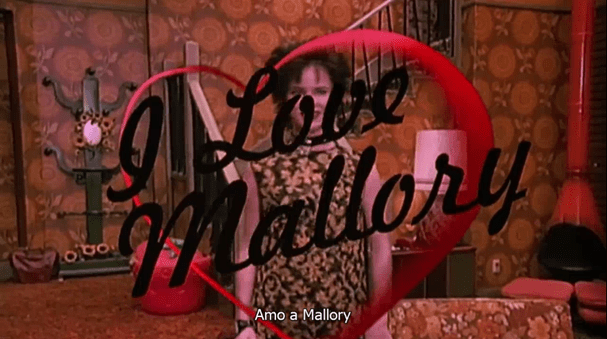
Scene from the family parody “I love Mallory” in Natural Born Killers. Source: Warner Bross, 1994
And here we connect with Baudrillard’s idea that we live in a simulacrum where the real has lost transcendence and in its place we now live simulated experiences, sustained in basic realities (which are those constructed and represented by the media) that operate under a logic of concealment and that have no relation with reality. Oliver Stone again brings this explanation to his film by satirizing the standard image of a perfect family constructed by the media, which is abysmally far from the true nature and complexity of a family structure.
The following video has been published with educational purpose. Copyrights by Warner Bros, 1994.
In terms of cinematography, the scene in “I Love Mallory” is composed primarily of close-up shots of each character. In the traditional television style of a series, wide shots are prevalent, because they show an ensemble of characters and their comedic responses to given situations. In these programs, there is a common theme related to family and unity, although there is tension or disputes (usually comical). These shows tend to emphasize integrity built by love and unconditional support of others. However, in Stone’s constructed satire, close-ups consistently reveal individuality. This family is not a whole or a unit in any form. There is nothing to indicate a relationship of integrity because the centers of this family revolve around a selfish father and a dysfunctional family (a daughter who experiences constant abuse from her father, a mother who lacks the authority or courage to stand up to her husband, and a growing son who thinks this is how families are formed). This cinematic style addresses the fact that not all American families have the glamorous home style portrayed in television series, no matter how hard the media tries to portray the image of that perfect family.
BIBLIOGRAPHY:
Bugess, Laina. (2013). Natural Born Killers: Aesthetics and Analysis. Publicado en Storify.com. url: https://storify.com/lburgess3/natural-born-killers-aesthetics-and-analysis
Boorstin, Daniel J. (1962). The Image: Or, What Happened to the American Dream, New York: Atheneum.
Debord, Guy (2005). La sociedad del espectáculo, Madrid. Editorial Pre-Textos,
Holmes, D. (2005). Communication Theory Media, Technology and Society. SAGE Publications Ltd.
Thompson, J.B. (1995). The Media and Modernity: A Social Theory of the Media, Stanford, CA: Stanford University Press.
 Nihilitus